
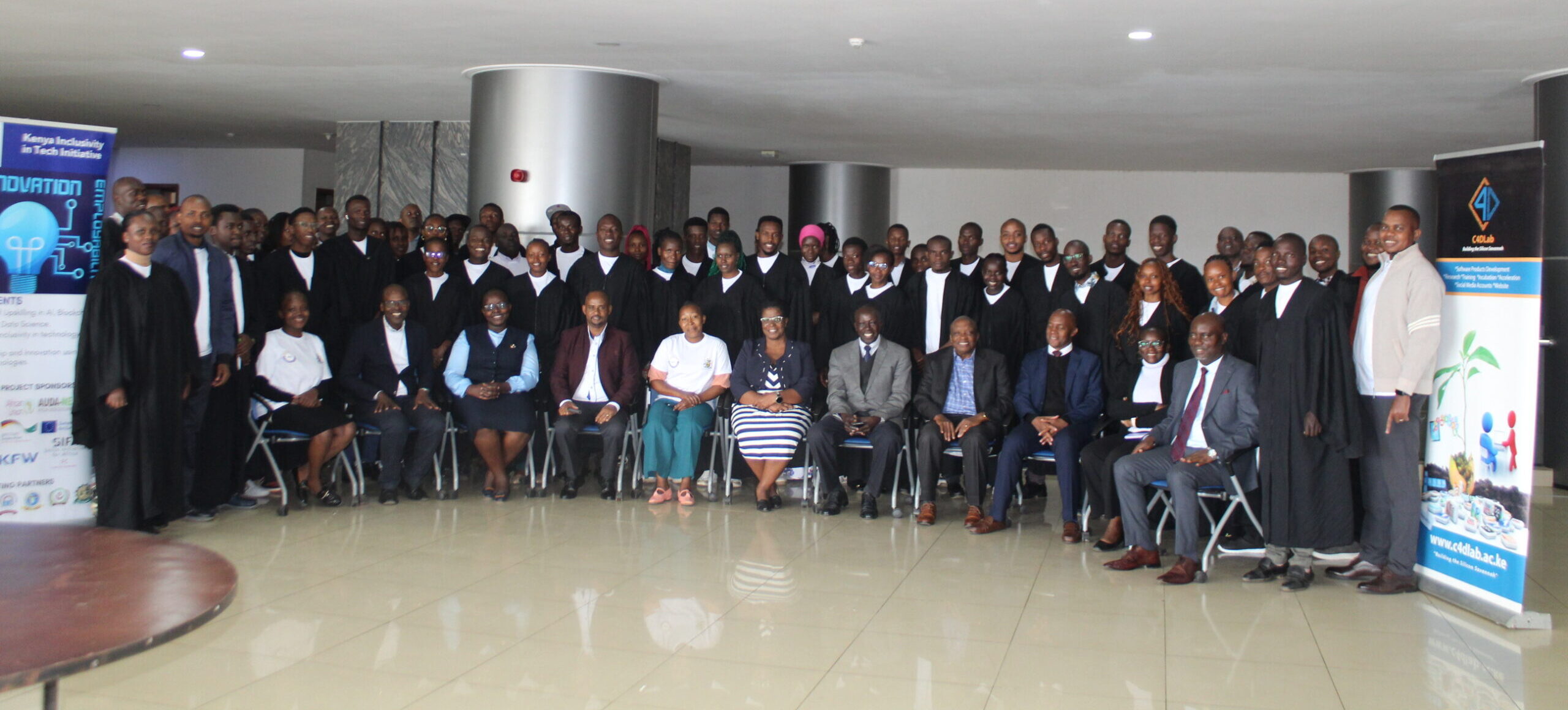
The University of Nairobi marked a significant milestone in Kenya’s digital transformation journey on Friday, 24 July 2026, as it hosted the inaugural Kenya Inclusivity in Tech Initiative (KITI) Graduation Ceremony at the University Towers. The colourful event brought together students, university leadership, principals from partner Technical and Vocational Education and Training (TVET) institutions, development partners, faculty members, and industry stakeholders to celebrate a new generation of graduates equipped with the digital skills required to thrive in the Fourth Industrial Revolution.
The ceremony recognized 50 graduands from participating TVET institutions who successfully completed the Kenya Inclusivity in Tech Initiative (KITI), a programme designed to bridge the digital skills gap by equipping young people with competencies in Artificial Intelligence (AI) and Machine Learning , Cybersecurity, Internet of Things (IoT), Big Data Analytics, and Blockchain Technology. Following months of structured learning, practical assignments, collaborative projects, and continuous mentorship, the graduates emerged with industry-relevant skills that position them to contribute meaningfully to Kenya’s rapidly evolving digital economy.
In recognition of protocol, the ceremony was graced by distinguished guests led by the Skills Initiative for Africa (SIFA) Country Director, Mr. James Wamwangi, alongside the Ag. Dean, Faculty of Science and Technology, Prof. Francis Nyongesa, and the Chair of the Department of Computing and Informatics and Principal Investigator of the KITI Programme, Prof. Elisha Abade. Also present were principals and representatives from the participating TVET institutions, members of faculty, programme partners, and other invited guests, whose collective presence underscored the importance of collaboration in advancing digital inclusion and skills development across Kenya.
Speaking during the ceremony, Mr. James Wamwangi congratulated the graduands for successfully completing a programme that has empowered them with future-ready digital competencies. He commended the University of Nairobi and its partners for implementing an initiative that expands opportunities for young people while strengthening Kenya’s innovation ecosystem. He encouraged the graduates to view their certificates not as the end of their journey but as a foundation upon which they can build impactful careers, innovative enterprises, and lifelong learning.
Representing the University leadership, Prof. Francis Nyongesa applauded the graduates for their resilience, commitment, and determination throughout the programme. He noted that the KITI initiative demonstrates the University of Nairobi’s commitment to building meaningful partnerships with TVET institutions to deliver high-quality, industry-aligned education that responds to the needs of a rapidly changing world. He challenged the graduates to become ambassadors of innovation, using their knowledge and skills to develop solutions that address societal challenges while contributing to national development.
Prof. Elisha Abade reflected on the vision behind the Kenya Inclusivity in Tech Initiative, noting that the programme was established to bridge the gap between academic learning and the practical digital competencies demanded by today’s labour market. He emphasized that beyond technical knowledge, KITI seeks to nurture innovators, entrepreneurs, and problem-solvers capable of leveraging technology to transform industries and improve livelihoods. He encouraged the graduands to continue advancing their skills through research, innovation, entrepreneurship, internships, and lifelong professional development.
One of the most inspiring moments of the ceremony came from the principals and representatives of the participating TVET institutions, who celebrated the achievements of their students and reaffirmed their commitment to strengthening digital education within their institutions. In their words of encouragement, they reminded the graduates that the knowledge they had acquired carried a responsibility to innovate, mentor others, and become agents of positive change within their communities. They challenged them to embrace emerging technologies, pursue excellence, and create employment opportunities rather than merely seeking them, emphasizing that the future of Kenya’s digital economy will be shaped by young innovators willing to solve real-world challenges.
The graduation ceremony also highlighted the power of strategic partnerships. Through the collaboration between the University of Nairobi’s C4DLab, the Skills Initiative for Africa (SIFA), AUDA-NEPAD, the African Union, and participating TVET institutions, KITI has successfully created pathways that make advanced digital skills more accessible to young people across the country. The programme demonstrates how universities, technical institutions, development partners, and industry can work together to build an inclusive innovation ecosystem that prepares graduates for employment, entrepreneurship, and leadership in the digital economy.
Across Kenya and the wider African region, initiatives focused on emerging digital technologies are increasingly transforming how institutions prepare young people for the future of work. Similar digital skills programmes have demonstrated that investments in Artificial Intelligence, Cybersecurity, Data Science, and connected technologies significantly improve graduates’ employability, foster innovation, and stimulate entrepreneurship. The KITI programme joins this growing movement by equipping graduates not only with technical competencies but also with the confidence to develop technology-driven solutions capable of addressing challenges in agriculture, healthcare, education, manufacturing, financial services, and public service delivery.
For the 50 graduands, the ceremony marked the beginning of a new chapter rather than the conclusion of one. Armed with practical experience, industry-relevant knowledge, and a strong network of mentors and partners, they are now well-positioned to pursue employment opportunities, launch startups, undertake further studies, and contribute to Kenya’s expanding digital economy. Their success serves as a powerful reminder that when universities, TVET institutions, development partners, and industry collaborate around a shared vision, they create opportunities that extend far beyond the classroom and transform lives.
The University of Nairobi congratulates the inaugural KITI graduating class and expresses its sincere appreciation to the participating TVET institutions, programme partners, faculty, mentors, and the Skills Initiative for Africa (SIFA) for their unwavering commitment to nurturing the next generation of digital innovators. As these graduates step into the next phase of their journeys, they carry with them not only certificates but also the skills, confidence, and ambition to shape the future of technology and innovation in Kenya and across the African continent.