By Day Three, the AFRETEC Makerthon 2026 at the University of Nairobi’s C4DLab had fully transitioned into a builder’s space. The conversations became more concrete, the pace more deliberate, and the ideas—once abstract—began to take visible form. There was a clear shift in the room: from thinking and discussing to creating and testing.
The day’s sessions, led by Ernest Kimani, centered on one core idea—prototyping is not about perfection; it is about learning.
Participants were guided to see prototypes not as final products, but as tools for answering critical questions. What problem are we solving? Does the solution make sense to the user? Where does it break? What needs to change? This mindset encouraged teams to build with intention, focusing less on polish and more on insight.
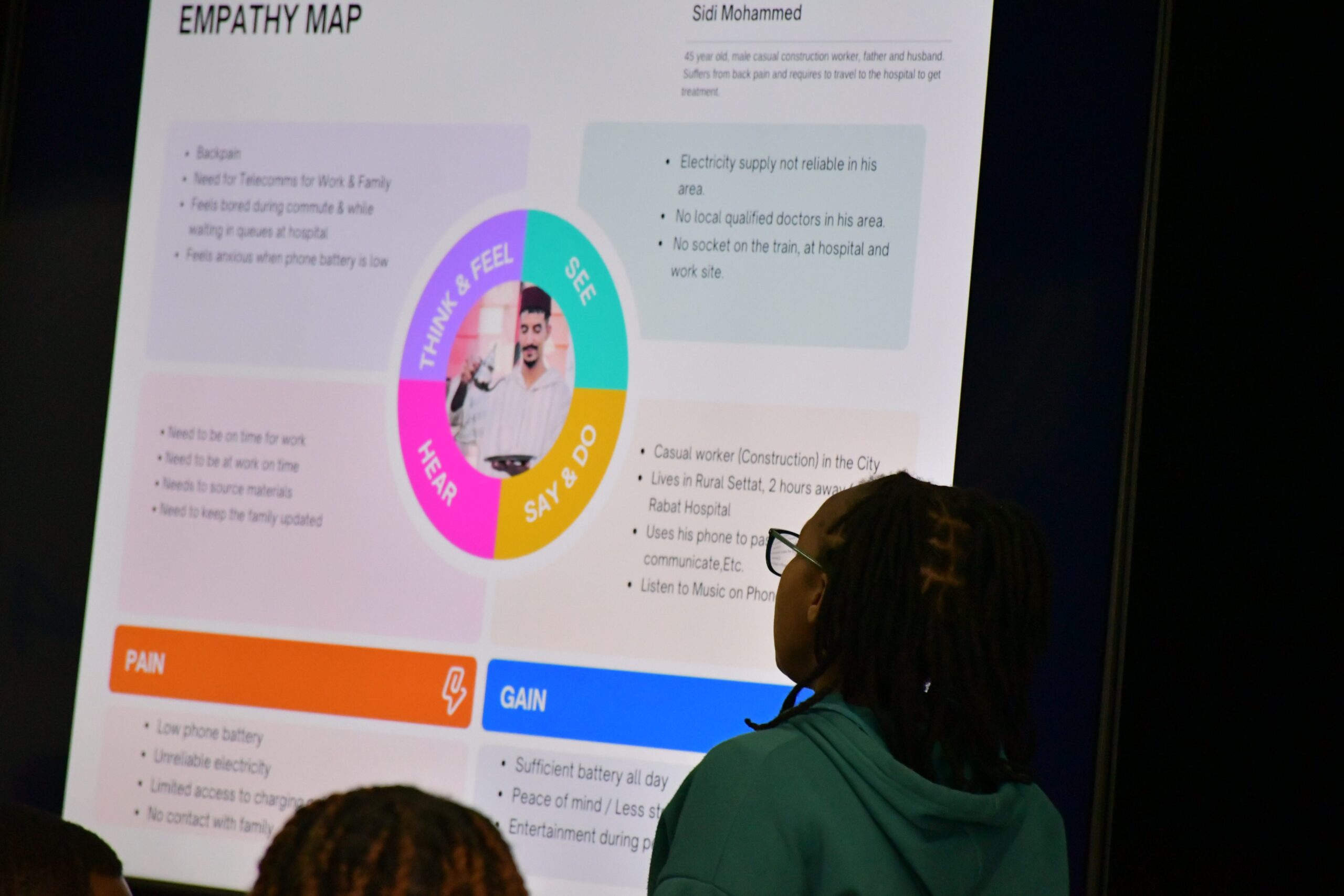
The environment at C4DLab reflected this philosophy. Teams were deeply engaged—sketching ideas, mapping user journeys, building quick models, and constantly interacting within and across groups. There was a strong sense of openness, with teams exchanging feedback, testing each other’s assumptions, and refining their approaches collaboratively. The Makerthon space evolved into a living lab, where ideas were continuously shaped through interaction.
A key focus of the day was understanding different levels of prototyping fidelity:
- Low-fidelity prototypes allowed teams to quickly visualize concepts using sketches, paper models, or simple workflows. These were fast, flexible, and ideal for early exploration.
- Mid-fidelity prototypes introduced more structure, enabling teams to simulate user interactions and test functionality in a more defined way.
- High-fidelity prototypes moved closer to real-world applications, incorporating detailed design and functionality to better represent the final solution.
Rather than treating these as separate stages, teams were encouraged to move fluidly between them—choosing the right level of fidelity depending on the questions they needed to answer.
The session also introduced teams to agile development principles, reinforcing the importance of iterative progress. Instead of attempting to build complete solutions at once, participants were guided to work in small, continuous cycles—build, test, learn, and improve. This approach allowed teams to remain adaptable, responding quickly to feedback and new insights.
Closely tied to this was the concept of the Minimum Viable Product (MVP). Teams were challenged to identify the simplest version of their solution that could still deliver value and be tested effectively. This required clarity of thought—distilling ideas to their most essential components while maintaining relevance to the problem at hand.
Throughout the day, one theme remained consistent: tangibility. Ideas had to be seen, touched, and experienced. Whether through sketches, mock-ups, or interactive models, teams worked to make their thinking visible—not just for themselves, but for others to understand and engage with.
By the end of the day, the progress was evident. Teams had moved beyond concepts into working representations of their solutions. More importantly, they had begun to answer key questions about feasibility, usability, and impact.
Day Three reinforced a critical aspect of innovation—it is through building that ideas truly come alive. With prototypes now in hand, teams are better positioned to refine, test, and move closer to solutions that can make a meaningful difference.